From Portfolio to Factories: Reading CBN’s Policy Signals and Reigniting FDI in Nigeria
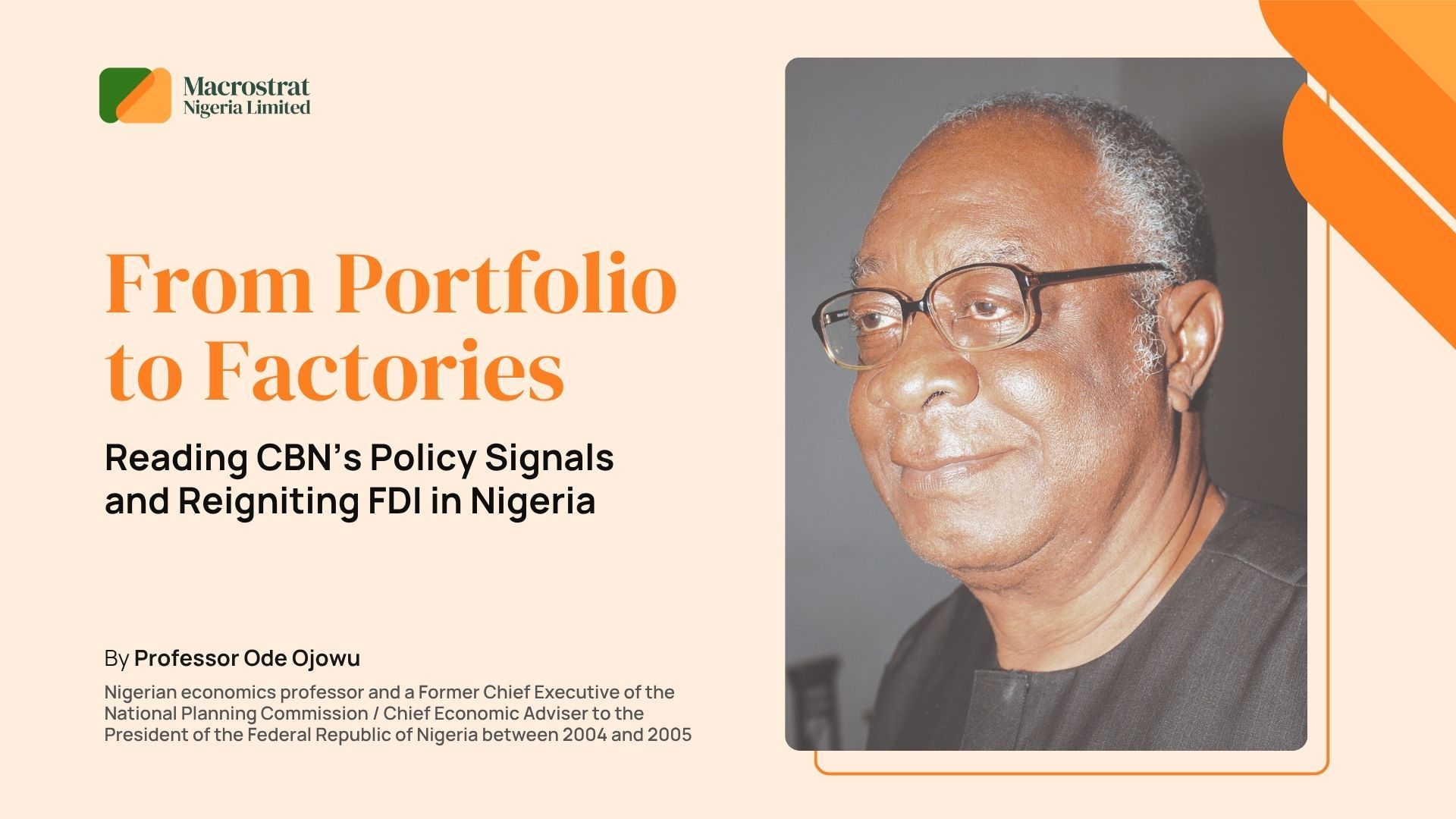
The challenge of the CBN is like that of a master helmsman steering a ship with a perfect compass, while the crew members below decks keep drilling holes in the hull.steering a ship with a perfect compass, while the crew members below decks keep drilling holes in the hull.
Introduction
Nigeria’s Q1 2026 capital importation figure of $10.37bn is not just a number. It is a verdict from global investors on CBN’s monetary direction. The National Bureau of Statistics reports that 95.1% of this inflow was portfolio investment, while Foreign Direct Investment accounted for only $135m, or 1.3%. To understand what this means, we must read the sequence of policy moves by the CBN that has brought us here.
–
CBN is on track: The policy sequence tells the story
The Central Bank began 2026 by lowering the Monetary Policy Rate in February, signalling that inflation was responding to tight policy. Since then, CBN has held MPR high and steady. That stability matters more than the level. Investors hate surprises. A stable 27.5% MPR gives them a clear benchmark to price risk. In May 2026, CBN took the next step and dropped forbearance. For three years, banks had been allowed to delay recognition of bad loans and to breach single obligor limits. Ending forbearance forces banks to face reality, raise capital, and clean their books. Painful in the short term, but it restores trust in the banking sector.
Now in mid-2026, the market is confirming that trust. CBN, acting for DMO, just raised ₦1.475 trillion in a single Nigerian Treasury Bills Primary Market Auction. That is not luck. It is the direct result of the February MPR cut plus steady hold, followed by forbearance exit. Banks have emerged stronger and bought T-bills at 20 to 23 percent yields. Foreign portfolio investors saw clean banks plus stable rates plus FX unification, and they followed. That is how Q1 delivered $9.86bn of portfolio inflows.
Monetary policy has done its job on the capital account. It has made Nigeria attractive to “hot money” that seeks high yield and quick exit. The challenge now is to make Nigeria attractive to “patient, or deep money” that builds factories.
–
What inflows are forecast to look like through Q4 2026
If CBN keeps MPR stable and inflation continues its slow decline from the 15.69 percent, then three rule-of-thumb outcomes are forecast:
1.Portfolio inflows are forecast to stay strong:
Conditional on stable MPR and attractive real yields, portfolio flows are likely to remain in the $8 to $12bn per quarter range from T-bills, OMO and Eurobonds. This would continue to support FX stability and reserve accumulation.
2.FDI is forecast to rise, but slowly:
Without additional fiscal reforms to cut production costs, FDI is likely to crawl from $135m in Q1 toward the $200 to $300m per quarter range by Q4 2026. That would still leave FDI under 3 percent of total inflows, meaning the $10bn plus quarterly headline would continue to mask a shallow capital account.
3.The mix risk remains:
A capital account dominated by portfolio money is efficient, but fragile. Portfolio flows can reverse quickly if global rates rise or oil prices fall. FDI enters slower, but also exits slower. Nigeria needs both to build resilience.
–
The challenge: Existing FDI policies are not failing, but they are incomplete
Nigeria already has a liberal FDI framework. I was a member of the Abacha’s National Economic Intelligence Committee (NEIC)1994-1999, when the NIPC Act of 1995 was promulgated to replace the old, restrictive investment regime from the indigenization era. NIPC guarantees 100 percent foreign ownership and free repatriation. Pioneer Status offers 3 to 5 years of tax holidays. Free Trade Zones give duty-free imports and zero profit tax. Double taxation treaties reduce withholding tax. But all these rules explain only why investors can enter the Nigerian economy easily.
The challenge is not at the gate. It is inside the factory. A tax holiday is worthless if diesel costs ₦1,050 per litre and power runs 7 hours a day. A repatriation guarantee is cold comfort if land title takes two years to acquire and cargo sits at port for 3 weeks. Portfolio investors do not care about power cuts. A manufacturer does. We discovered this challenge in the Federal Ministry of Industry in the early 1990s when we researched into country comparisons of industrial policies. For similar tax incentives on paper, Morocco continues to attract 35 percent FDI share while Nigeria’s FDI inflow gets stuck at below 3.0 percent.
I may not be up to date in development in the policy environment, so my suggestions below should be weighed against the latest update in policy practice:
–
Strategy to enhance FDI: Build a “Cost and Trust Layer” on existing policies
CBN has fixed the monetary signal. Government must now fix the cost signal. The goal is not to replace NIPC or Pioneer Status, but to make them work.
1.Cut the denominator of production cost:
Deliver 12 hours of reliable power and mass CNG transport in industrial corridors of Lagos, Kano, Aba, Port Harcourt, Kaduna and Onitsha. Every 10 percent drop in energy and logistics cost is forecast to add 3 to 5 percent to factory margins. Reducing the critical production cost turns Pioneer Status from a paper incentive into real profit.
2.Extend the FTZ model to industrial corridors:
Free Trade Zones work relatively well because security, power and customs come in a bundle. Declaring Lagos-Abeokuta, Kano-Kaduna and Aba-Port Harcourt as “FDI Security Corridors” with joint security funding and a single 30-day investment permit window at NIPC is forecast to reduce time-to-investment and improve investor confidence.
3.Reward outcomes, not inputs:
Upgrade the 20 percent tax credit for local raw materials to a “Make in Nigeria Export Credit” for firms that export at least 50 percent of output and source at least 40 percent of input locally. Ethiopia’s textile sector followed this pattern between 2015 and 2019 and it worked. Addis Ababa did not grant tax breaks to every factory that opened. It tied incentives to performance. Firms had to export 60 to 80 percent of output to qualify for duty-free imports and tax relief, while government pushed them to source cotton locally by locating industrial parks near cotton belts. The result was predictable. Foreign textile firms from China, India and Turkey invested in Ethiopia because export rules guaranteed them foreign exchange for repatriation, reducing currency risk. Local cotton use cut input costs over time, and industrial parks bundled power, water and customs so the cost math worked. Apparel exports grew from about $115m in 2014 to $150 to $180m by 2019. The lesson for Nigeria is that FDI in manufacturing responds less to blanket tax holidays and more to rules that make exporting and using local inputs cheaper and safer for the investor. This credit aligns private profit with Nigeria’s foreign exchange needs, following that same logic.
4.De-risk both security and legal guarantees:
The NIPC Act promises repatriation, but investors want insurance. Offering political violence and FX transfer risk cover through Africa Finance Corporation and Nigerian Export-Import Bank, backed by government premium support, is forecast to turn a legal right into a bankable guarantee. Political risk insurance for infrastructure and industrial projects is part of AFC portfolio and that of NEXIM too.
5.Align fiscal policy with monetary gains:
Forbearance fixed bank balance sheets, but fiscal laxity is forecast to continue muting CBN’s policy impact on growth and development. The ₦22.7 trillion Ways and Means securitized in 2023 is a powerful reminder of the long-term burden the economy suffers from fiscal indiscipline. While securitization removed CBN’s direct exposure, the interest and principal now sit on government’s books for 40 years, consuming fiscal space and increasing the probability that CBN must keep MPR higher for longer, since large deficits must be financed without monetary accommodation. To protect monetary gains, CBN is strongly advised to add more value by becoming active in the fiscal space through technical support: providing data, debt sustainability analysis, including the securitized stock, and early warning on inflationary spending. CBN must resist any resort to new Ways and Means financing and strengthen administrative involvement in guiding the presidency on fiscal choices that affect price stability. This is not a call for CBN to take over the fiscal role, which was the mistake of the past that blurred accountability. Rather, it is a call for the CBN to assume informal leadership and provide stronger fiscal-monetary policy coordination, whereby monetary policy sets the anchor and fiscal policy sails within it. If inflation falls as forecast, CBN would then have scope to gradually ease MPR. At 18 percent MPR and 12 percent inflation for example, T-bills would yield about 6 percent real return, and capital is forecast to begin to shift from paper to plants.
–
Conclusion: From hot capital to deep capital
CBN’s sequence of lower MPR in February, steady hold, forbearance exit in May, and successful ₦1.475tn NTB auction now shows a central bank that is consistent and credible. That credibility unlocked $9.86 bn in portfolio inflows.
The next phase is harder. It belongs to fiscal policy and economic management. Nigeria does not need new FDI laws. It needs to reduce the cost of living and the cost of doing business so that existing laws can deliver factories, not just T-bills.
If government delivers on power and transport while CBN keeps the monetary anchor and fiscal policy stays disciplined, then Q4 2026 is forecast to show a healthier mix with total inflows around $10bn and FDI potentially near $1bn, instead of $135m. That is the shift from a hot capital account to a permanent or deep one. Portfolio money stabilizes the naira. FDI builds the future.
Ode Ojowu