Nigeria’s FX Activity Rises as the Naira Adjusts
Executive Summary
Oil displaced AI as the market’s chief worry. Brent settled at $116.72 on 23 Oct, its highest since late April, after Houthi attacks on Saudi Arabia; the Nasdaq fell 2.6% on 22 Oct, its worst day since June. Nigeria’s naira lost about ₦29.6 against the dollar over the week despite record $1.01bn interbank turnover and reserves near $55.2bn. Next week’s decisions are the Fed (28 Oct), ECB (29 Oct) and Bank of Japan (30 Oct), alongside US Q3 GDP and PCE on 29 Oct.
–
Introduction
This note reviews 18–24 October and previews 25–31 October 2026 for the world, Africa and Nigeria.
–
The World
Review
US equities ended lower: S&P 500 7,623.68 (−0.5% on the week), Nasdaq 25,955.34, Dow 52,215.16. The return-on-investment reassessment of tech funding needs, wider credit spreads and a flight to quality that produced Thursday’s (22 Oct) biggest one-day Treasury rally since Silicon Valley Bank. Macro data stayed firm: jobless claims 194,000, PMI 56.0, but Michigan one-year inflation expectations rose to 4.7%. China’s Q3 GDP grew 4.5% y/y (19 Oct), above the 4.4% consensus, within the 4.5–5% target. UK inflation hit 3.5% in September (21 Oct), above the 3.4% forecast; Eurozone PMI slipped to 51.9; France trades about 170bp over Germany.
Energy was the standout: Brent rose about 6% on the week and WTI settled at $103.27, with the S&P energy sector at a record high; the 10-year Treasury yield fell back from above 5% to about 5%. In China, September retail sales rose 1.1% and industrial output 5.5%, but property investment is down 20.6% in nine months and the trade surplus widened. UK input prices rose 8.3% y/y and borrowing exceeded forecasts. AI adoption is broad but shallow and risk mitigation weak, so the path from innovation to productivity and earnings may disappoint; Meta, Tesla, Procter & Gamble and United Rentals gave upbeat commentary, and PMI job growth was the strongest since March 2012.
Outlook
The Fed is expected to hold on Wed 28 Oct, with markets pricing hikes from December; rate rises are the wrong tool for supply-driven inflation. PCE (29 Oct) is forecast at 0.5% m/m headline, 0.3% core (3.6% and 3.1% y/y) alongside Q3 GDP and the Employment Cost Index. The ECB decides 29 Oct, the BoJ 30 Oct, Eurozone Q3 GDP follows 30 Oct, and China’s PMIs land 31 Oct. Brazil’s runoff (25 Oct) is too close to call, the UK Budget is imminent, and Alphabet, Microsoft and Amazon report capex plans. Before the Fed, the US publishes durable goods, FHFA house prices and Conference Board confidence (27 Oct). The ECB is expected to hold while watching sovereign spreads, with French Q3 GDP and flash inflation closely scrutinised. Japan’s PPI, industrial output and Tokyo core CPI will show whether the BoJ must tighten faster, and earnings from GE, AT&T, United, Meta and Tesla complete a heavy calendar. Key risks: Brent above $116, bond-market fragility in France, Japan and the UK, and a disorderly AI de-rating.
–
Africa
Review
Inflation rose in eight of 16 African economies in September; Kenya reached 6.8%, its highest since January 2024, while Nigeria, Egypt, Angola and Botswana declined. South Africa’s core inflation eased to 4.0% (21 Oct) against a 4.3% forecast, though headline reached 4.5% on fuel. Senegal’s creditors named Houlihan Lokey adviser, and South Africa drafted rules allowing 100% offshore mandates. Outlook
Egypt’s rate decision is due 29 Oct and Kenya’s October CPI on 30 Oct (forecast 7%). Oil near $117 helps exporters and strains importers’ fuel and food bills.
–
Nigeria
–
– Review
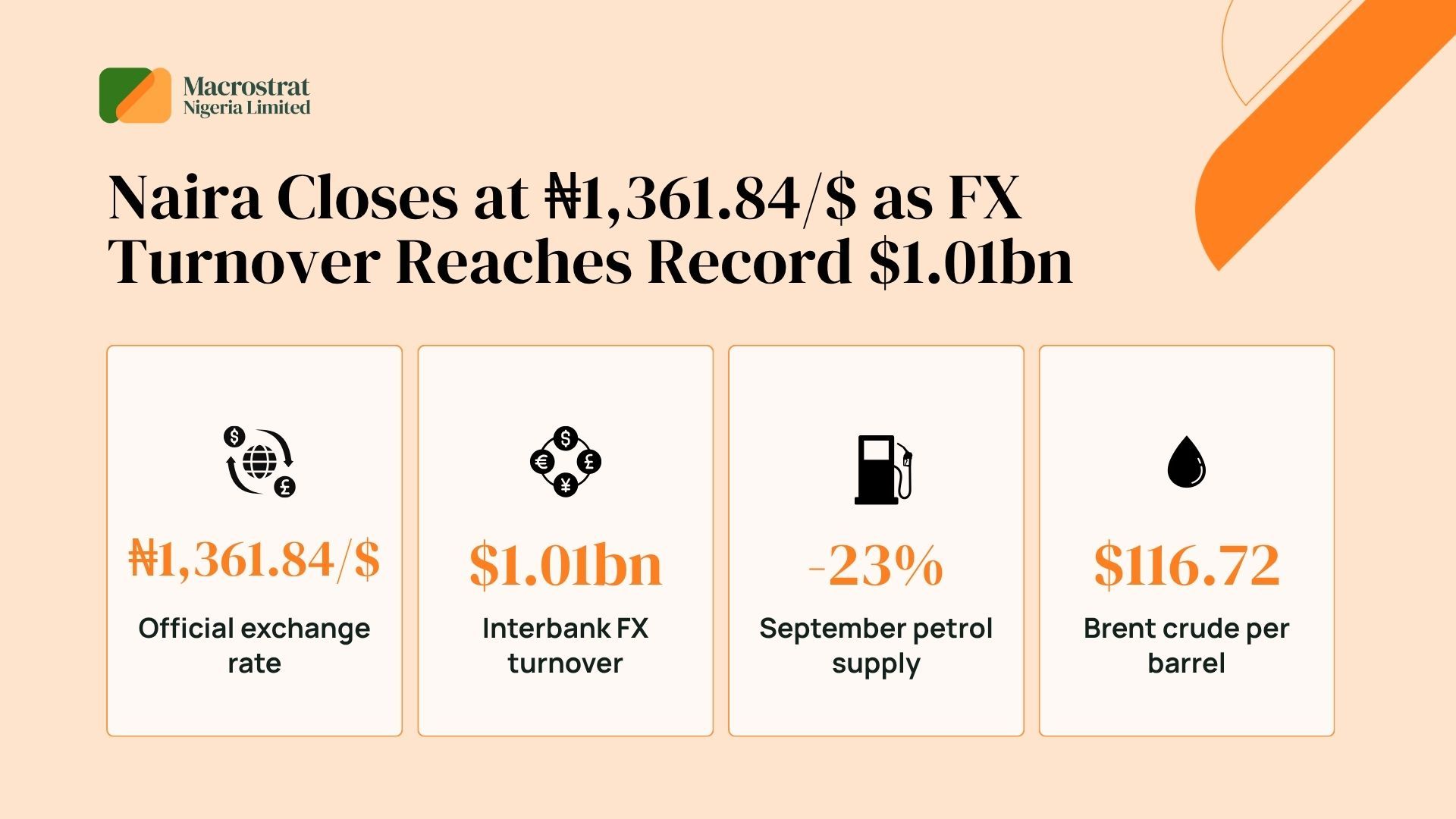
The naira closed at ₦1,361.84/$ on 23 Oct, its weakest official rate since August, on record $1.01bn turnover; the CBN stepped up dollar sales. Reports differ on 22 Oct: ₦1,344.40 on the CBN series versus ₦1,365. Gross reserves reached $55.16bn. Broad money (M3) rose 5.4% to ₦146.6tn in September. Despite the 350bp cut to 23%, OMO yields rose at the 22 Oct auction (₦2.63tn sold against ₦2tn offered) and overnight rates stay near 20%. The NGX ASI closed at 247,222.27 (+0.92% on 23 Oct, +58.87% YTD); First HoldCo’s nine-month pre-tax profit rose 61% to ₦911bn, and Unilever’s profit rose 20% to ₦26.4bn. September petrol supply fell 23% as Dangote’s petrol exports rose 59%; non-oil exports hit ₦12.36trn in 2025.
Policy and sector news was busy. On trade, the Ministry launched a Trade Intelligence Report, and President Tinubu reportedly ordered unpaid Export Expansion Grant claims up to 2022 settled; the African share of non-oil exports rose to 15.4%. On industry and energy, Dangote lifted output 13% to 47.22m litres a day while diesel receipts fell 40%; the Power Minister alleged factories draw 150MW a day illegally, with about $18bn of development finance committed. On financial regulation, the CBN gave JPMorgan approval-in-principle for a merchant bank. Market breadth was weak, with 25 decliners to 23 gainers, and the BDC rate was ₦1,375/$. Earlier in the week the NGX shed ₦103.6bn to a weekly low.
Outlook
Watch Monday’s naira open and CBN sales; the Dangote Refinery IPO closes 27 Oct at ₦525 a share; Dangote Cement’s board meets 27 Oct; telecom CEOs face the House on 28 Oct; and NNPC’s petrol discount ends 31 Oct. No fresh official GDP, PMI, unemployment or balance-of-payments prints fall in this window. Expect the CBN to keep selling dollars while demand is heavy; a second week of record turnover would test the view that reserves of $55.16bn can cap volatility. Liquidity is the other variable: if OMO yields stay near 17% against a 23% policy rate, credit relief will lag. Q3 results from banks and industrials continue, and Brent above $116 supports export receipts and reserves but raises pump-price risk once the NNPC discount lapses.
–
Conclusion
A resilient US economy sits beside oil above $116, a wobbling AI trade and hawkish central banks, so the world enters the Fed week with inflation, not growth, as the binding constraint. Africa is divided between oil exporters that gain and importers that absorb costlier fuel. Nigeria’s buffers are strong, with reserves above $55bn and bank earnings rising, but a weaker naira, rising OMO yields and a fuel-supply squeeze show that the rate cut has not yet reached households or firms.
–
Recommendations
Policymakers: publish FX-intervention data promptly, track lending-rate pass-through, and prioritise domestic fuel supply over export volumes while shortages persist. Businesses: hedge dollar inputs now, lock medium-term funding before December hike pricing bites, and budget fuel at $110+ Brent.
Investors: favour earnings-backed NGX names such as banks reporting fee growth, keep liquidity for the Fed, PCE and big-tech capex events, and treat further Nasdaq weakness as a global risk signal.