Nigeria’s Inflation Falls. When Will Borrowing Get Cheaper?
Executive Summary
The week of 12–18 October 2026 was defined by the IMF–World Bank Annual Meetings in Bangkok, a hot US inflation print, and Nigeria's best disinflation reading in years. The IMF's October World Economic Outlook (13 October) projects global growth of 3.1% in 2026 and 3.4% in 2027, with global headline inflation rising to 4.7%. US September CPI accelerated to 3.7% year-on-year on a 9.1% monthly surge in gasoline, yet Treasury yields fell and the market-implied probability of an October Fed hike dropped below 20%. The NASDAQ fell 4.5% — its worst week since June — while Brent touched $110 intraday on 16 October. Nigeria's headline inflation fell to 14.63% in September and gross reserves hit $58.81 billion on 12 October, the highest since November 2008. Next week (19–25 October) turns on flash PMIs, China's Q3 GDP, Japan's CPI, a heavy corporate-earnings calendar and Brazil's presidential runoff on 25 October.
–
Introduction
This note reviews 12–18 October 2026 and previews 19–25 October 2026 across Nigeria, Africa and the world — monetary, fiscal, trade and FX policy, growth, inflation, balance of payments, capital flows, markets, AI/technology and earnings.
–
The World
Review: The IMF–World Bank Annual Meetings opened in Bangkok on 12 October — World Bank flagships 'Small AI, Big Jobs' and 'Mobilizing Private Capital for Jobs', Development Committee, Plenary. The IMF's October WEO lifted 2026 global growth to 3.1% — AI investment offsetting war-related energy damage — while warning on energy constraints, record public debt and the limits of policy coordination. US September CPI rose 0.6% month-on-month and 3.7% year-on-year (core 2.6%; energy +20.4% y/y; gasoline +9.1% m/m — over half the monthly gain). Unusually, yields fell on the hot data; equities saw sharp dispersion — NASDAQ -4.5%, S&P 500 -2%, Dow positive — with CoreWeave's credit spread spiking to 1,200 basis points. Brent touched $110 intraday on 16 October (close $109.86, +3.7% on the day) amid Hormuz tanker attacks and a US–Iran stalemate; WTI held above $100, gold fell to $4,187/oz, Bitcoin ended at $81,532. French spreads stayed 130–140bp over bunds, and the US waived Russia sanctions approved weeks earlier — an affordability-driven retreat before next month's midterms.
Outlook: With the Fed in blackout ahead of the late-October FOMC, 19–25 October brings US Michigan sentiment, home sales, PMIs and jobless claims; Eurozone and UK flash PMIs; UK CPI/PPI and labour data; China's GDP, retail sales and industrial production; Japan's trade, CPI and PMIs (feeding the BoJ tightening debate); and Brazil's presidential runoff on 25 October. The corporate calendar is heavy — 128 earnings releases on Thursday alone. Key risks: oil above $110, December Fed-hike pricing near 90%, and a disorderly AI-trade de-rating.
–
Africa
Review: In Bangkok, African ministers pressed the financing case against imported energy inflation, falling aid and heavy debt service, with AI's jobs impact and private-capital mobilisation the framing development questions. High oil is a wedge: exporters such as Nigeria and Angola gain terms of trade near $110 Brent, while importers face costlier fuel, fertiliser and food — keeping their central banks cautious. Nigeria's gross reserves reached $58.81 billion on 12 October, the highest since 19 November 2008.
Outlook: In 19–25 October, African markets trade on the IMF communiqué and global data: firm US inflation keeps dollar-funding costs high for importers, while exporters' currencies stay crude-supported. Watch Nigeria's reserve updates and money-market auctions, Kenya's path after September's 6.8% inflation print, and Bangkok follow-through on debt relief and concessional finance.
–
Nigeria
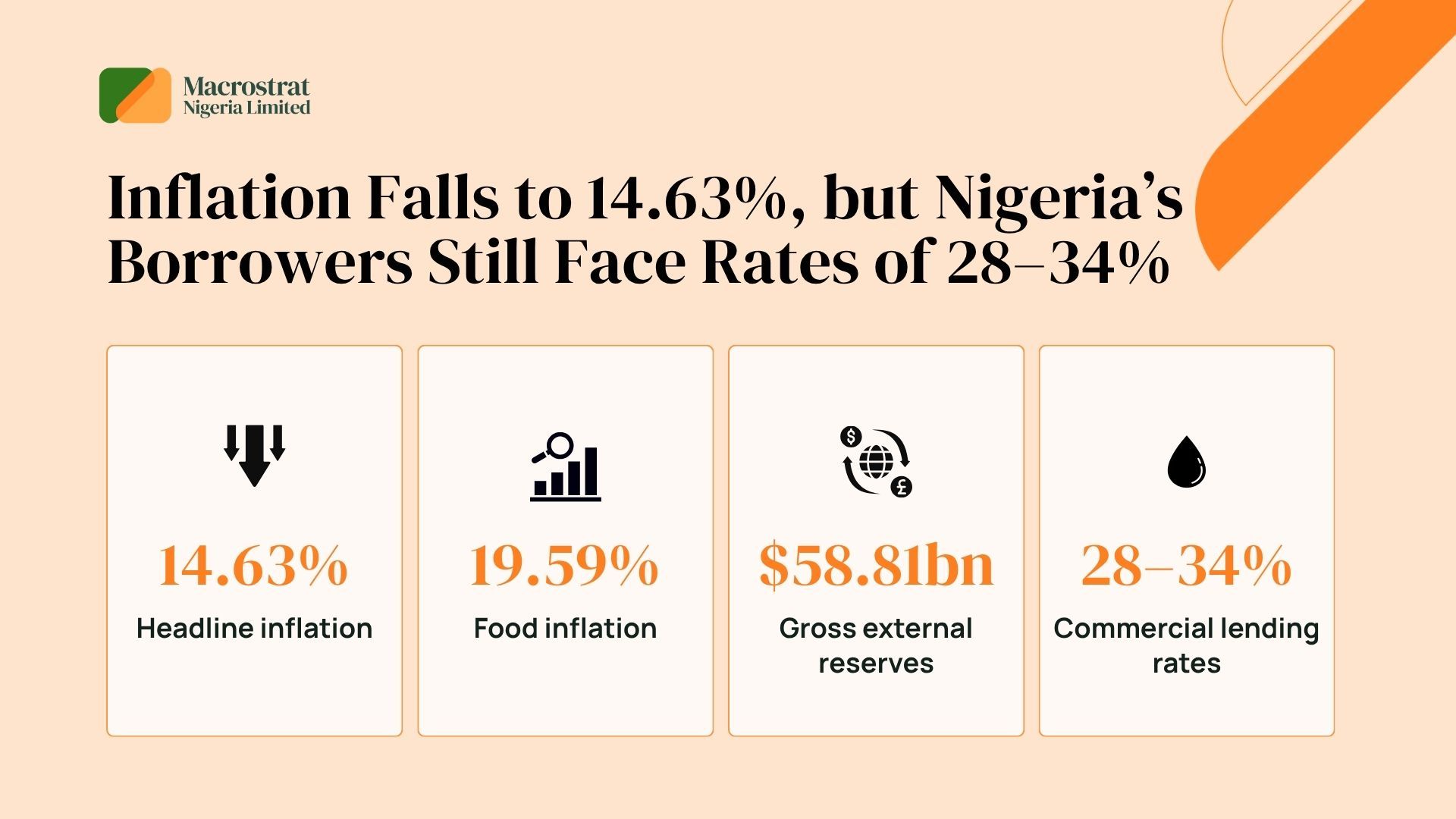
Review: The NBS September CPI report showed headline inflation at 14.63% year-on-year, down from 15.39% in August and 20.98% a year earlier, with month-on-month inflation of just 0.06%; food inflation eased to 19.59% y/y and fell 1.55% m/m, while core inflation printed 12.78%. The reading vindicates the CBN's September 307th MPC cut of 350 basis points to 23.00%, though transmission to 28–34% commercial lending rates and the 45% Cash Reserve Ratio remains the live policy question. Gross reserves climbed to $58.81 billion on 12 October (net ~$46 billion). The naira held near ₦1,331/USD, and the NGX All-Share Index closed the week at 247,486.89 points on 16 October, down 0.46% week-on-week but up 60.82% year-to-date. The Dangote Petroleum Refinery IPO continues to anchor market attention, with significant FX conversion expected post-allotment.
Outlook: For 19–25 October, watch: (i) pass-through of the MPR cut into prime and maximum lending rates; (ii) the next Treasury-bill auction and OMO calendars as liquidity shifts; (iii) weekly reserve accretion and naira stability with Brent above $100; and. Food inflation at 19.59% remains the binding household constraint — fiscal action on security and logistics, not monetary policy, is now the marginal disinflation tool.
–
 –
Conclusion
The global economy enters the final week of October resilient but strained: AI-powered growth forecasts sit alongside $110 oil, hot US inflation and a central bank that has stopped guiding markets. For Nigeria and Africa the external tailwinds — record reserves, upgraded growth, firm crude — are real, but domestic relief depends on credit transmission and food-supply fixes rather than headline numbers.
–
Recommendations
Policymakers: sustain reserve build-up and FX-market transparency; enforce pass-through of the 350bp MPR cut via published lending-rate monitoring; and tie any CRR easing to verified MSME and agricultural lending.
Businesses: hedge dollar inputs while the naira is stable, lock medium-term funding before December Fed-hike pricing tightens global conditions, and price in diesel risk at $100+ Brent. Investors: stay selective on the NGX, favour earnings-backed names ahead of Q3 results, and treat further NASDAQ-led tech de-rating as a portfolio signal, not noise.