Nigeria’s Inflation Is Easing. Will the CBN Change Course?
Executive Summary
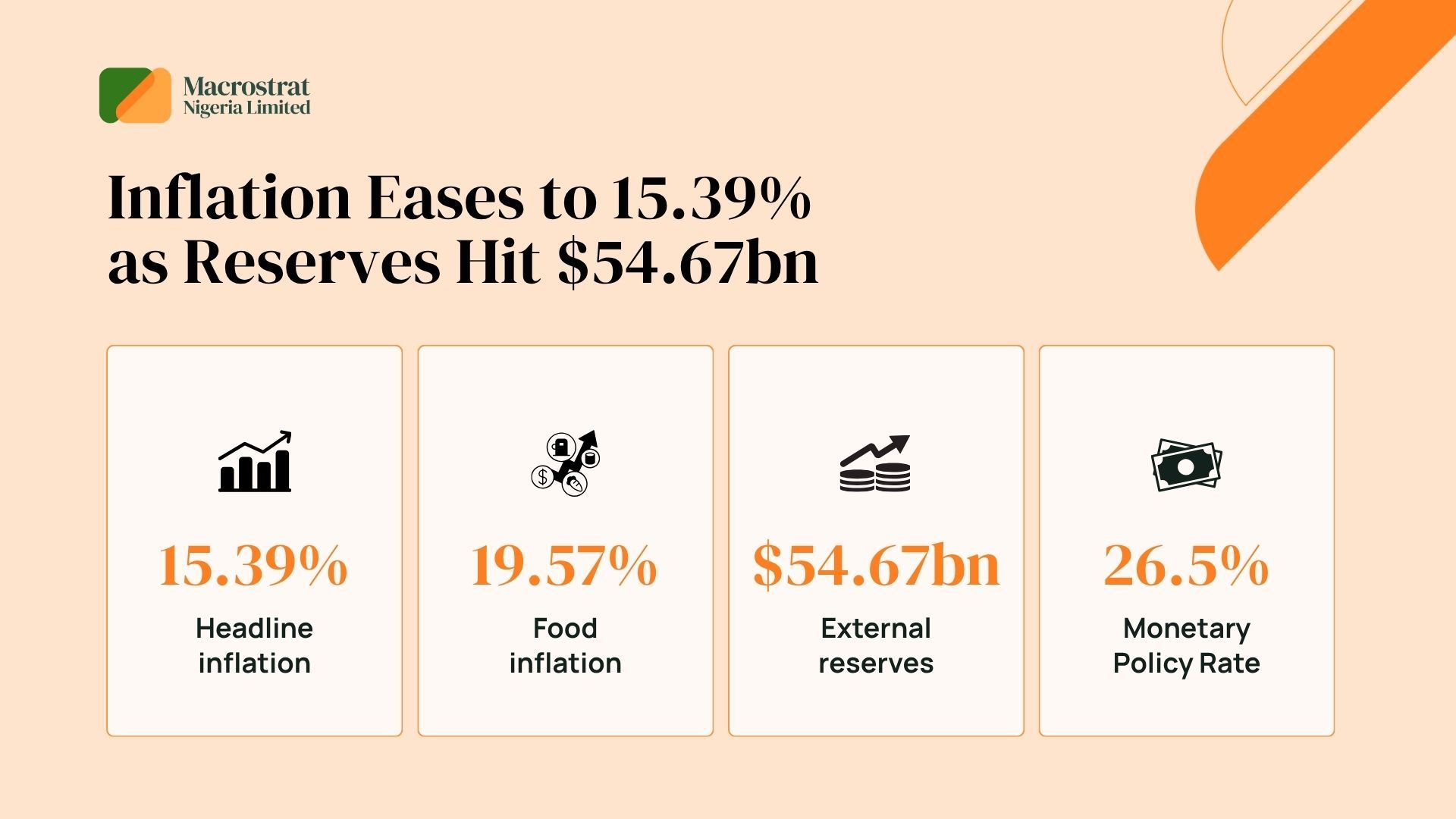
Nigeria enters the outlook period on improving fundamentals: headline inflation eased to 15.39% in August from 15.43% in July, with food inflation at 19.57% versus 25.30% a year earlier; external reserves reached an 18-year high of $54.67 billion on 16 September; and the N2.15 trillion Dangote Refinery IPO, opened on 14 September, reshaped the Nigerian Exchange. Globally, the Federal Reserve delivered its first-rate hike since 2023 on 16 September, 25 basis points to 3.75%–4.00%; the Bank of Japan tightened to 1.25% on 18 September and the Bank of England held at 3.75% on 17 September. The Fed’s decision briefly calmed markets before energy-supply shocks reasserted fragility. The week ahead centres on the CBN’s 307th MPC meeting (21–22 September), the SARB and Bank of Ghana decisions (23 and 24 September) and the Trump–Xi summit in Washington (24 September).
–
Introduction
This report presents Macrostrat Nigeria Limited’s weekly review for the week ended 20 September 2026 and the outlook for 21–27 September 2026, spanning Nigeria, Africa and the world.
–
PART I — THE WEEK IN REVIEW (13–20 September 2026)
Nigeria
- •Inflation: the NBS reported on 15 September that headline inflation eased to 15.39% y/y in August (CPI 146.3), with month-on-month inflation at 0.71% (1.57% in July), food inflation at 19.57% and core inflation at 13.29%.
- •BOP & FX: gross reserves reached an 18-year high of $54.67bn on 16 September; the naira closed at N1,331.28/$ on 17 September, with the parallel market at N1,392. BOP context (NBS, 7 September): Q2 trade surplus of N12.60tn on N41.44tn total trade and a current-account surplus up 68% y/y to $7.54bn.
- •Capital flows & fiscal policy: J.P. Morgan’s 14 September report gave Nigeria a 7.4% weight in its new GBI-EM Edge index, covering $17.47bn of eligible FGN bonds at an average 17.1% yield; the DMO called it a first step towards the flagship GBI-EM in 2027.
- •Markets: NGX capitalisation gained N1.665tn in three days to 16 September. The Dangote Refinery IPO opened on 14 September (4.1bn shares at N525, about N2.15tn), closes 13 October, with listing expected in November.
–
Africa
- •Ghana: inflation rose to 5.0% in August from 4.6%, below the Bank of Ghana’s 8%±2% target band; the MPC meets 22–24 September.
- •Continental: the World Bank projects Sub-Saharan African growth near 4.1% for 2026, warning that Middle East-linked fuel and food costs threaten to lift regional inflation.
–
Global
- •US Federal Reserve: on 16 September the FOMC raised the funds rate 25bp to 3.75%–4.00% by a 12–0 vote; 16 of 18 officials see at least one more hike in 2026, with 2026 PCE inflation projected at 3.7% and unemployment at 4.1%. Chair Warsh’s press conference temporarily calmed fixed-income volatility, anchored policy expectations and sparked an equity relief rally that energy news then overshadowed.
- •BoE / BoJ / others: the BoE held at 3.75% on 17 September by 6–3, with three members voting for a hike; the BoJ raised its rate to 1.25% on 18 September with two dissents, and the yen slipped past ¥157/$. El-Erian (2026a) stresses the correlation across central banks after the ECB’s hike the week before, the BoJ’s disappointing guidance, the BoE’s hawkish hold (a hike is priced soon), Brazil’s fifth straight cut and a Turkish circuit-breaker on levered equity positions.
- •Energy & yields: Brent settled at $103.87 and WTI at $100.30 on 18 September; US diesel hit a record $6.45/gal, Saudi Aramco told European refiners to expect no crude next month, and the 10-year Treasury yield, which topped 5% early in the week, stood near 4.98%. There was a Houthi claim of an attack on Riyadh airport.
- •Inflation & activity: UK CPI rose to 3.1% in August (released 16 September), with motor fuels up 23% y/y; China’s August retail sales grew just 0.4% and fixed-asset investment fell 7.2% in January–August, consistent with the picture of strong tech and export activity but weak domestic demand.
- •Geoeconomics: Canada’s talks on an EU Association Agreement, Trump’s renewed tariff threats against Ottawa and Brussels, Italian spreads trading below French OATs, and Warren Buffett’s exit as Berkshire chairman.
–
 –
–
PART II — THE WEEK AHEAD (21–27 September 2026)
Nigeria •Monetary policy: the CBN’s 307th MPC meets 21–22 September; with the MPR at 26.5% since February, disinflation intact and food/energy risks elevated, consensus favours a hold. •Markets: FTSE Russell’s reclassification of Nigeria to Frontier status takes effect on 21 September. Dangote IPO subscription continues to 13 October, and listing is expected to lift NGX capitalisation toward N200–225tn. Further NTB/OMO auctions are expected, with stop rates near 16.3–16.8% and ~20% respectively.
–
Africa •Ghana’s MPC decides on 24 September, with Databank Research expecting a cut from 14% to 12–13%. The SARB announces on 23 September with the repo rate at 7% after a 4–2 hold in July, two members favouring a hike; a move toward 7.25% is possible if oil-driven inflation persists. Watch Kenya and Egypt price data as Gulf disruption filters into import costs.
–
Global
- •Trump–Xi summit: Xi is due in Washington from 23 to 25 September, with talks on 24 September; the one-year Busan trade truce expires about five weeks later, and a package worth around $30bn in tariff relief is expected. The agenda: the Middle East and Ukraine wars, tariffs (including secondary tariffs), technology, industrial capacity and global imbalances, during UN General Assembly week.
- •Data & earnings: flash PMIs on 23 September for the US, Eurozone, Japan and UK; Germany’s Ifo and GfK; UK public finances; US current account and UMich sentiment; Brazil’s central-bank minutes. AutoZone and KB Home report on 22 September.
- •Oil & China: oil stays hostage to Hormuz/Red Sea repair timelines, and EIA’s September Outlook assumes constrained Middle East flows through Q4 2026; China’s refined-product exports rose 12.7% y/y in August.
–
Conclusion The week revealed a widening divergence between Nigeria’s improving fundamentals — faster growth, cooling inflation, record reserves and a landmark IPO — and a more hawkish, geopolitically fragile global backdrop, as the Fed’s first hike since 2023 and Gulf risk pushed oil, yields and the dollar higher together. With the CBN, SARB and Bank of Ghana due to decide alongside the Trump–Xi summit, markets enter the outlook period cautiously constructive on Nigeria and Africa but facing an energy system steadily depleting its buffers and a bond market whose capacity to absorb supply will be tested.