Nigeria’s Markets Gain Ground Ahead of November’s Business Activity Reading

Executive Summary
Tech earnings and oil, not central banks, moved markets. Alphabet fell 11% on 29 Oct after heavy AI spending left free cash flow negative; Intel dropped 29% on 30 Oct; and Brent’s December contract expired at $117.64 on 30 Oct, up 13.6% in October. The Fed held at 3.75–4% on 28 Oct. At home, the naira closed at ₦1,346.26/$ on 30 Oct, the NGX All-Share Index gained 2.86%, and Dangote Refinery raised about ₦2.15trn. Next week: Nigeria’s PMI (2 Nov), US midterms (3 Nov), the Bank of England (5 Nov) and US payrolls (6 Nov).
–
Introduction
This note reviews 25–31 October and previews 1–7 November 2026 for the world, Africa and Nigeria.
–
The World
Review. US growth accelerated to 3.4% in Q3 against 3.2% expected, while September PCE inflation rose to 3.6% (core 3.1%), both released on 29 Oct. On 28 Oct the Fed held at 3.75–4% in a 10–2 vote, Cook and Hammack preferring a hike; futures priced about 85% odds of a hike on 9 Dec. The Bank of Canada hiked 25bp while the ECB and Bank of Japan held, and Christine Lagarde said she will leave the ECB early. AI capex is the pressure point: Alphabet spent $51.3bn in the quarter, posted free cash flow of −$9.1bn and raised $28.7bn of debt, while Microsoft spent $45.2bn yet kept cash flow positive. Safe havens failed: gold fell to $3,885, Bitcoin sank below $78,000 after a $6.3bn Binance hack, and the 10-year Treasury yield ended at 4.93% after a 36bp October fall. WTI settled at $104.12 on 30 Oct after a tanker attack in Hormuz and Houthi claims on Saudi sites.
Outlook. The US midterms on 3 Nov will shape regulation and Middle East policy. October payrolls are forecast at 65,000 jobs, unemployment at 4.2% and ISM services at 54.8; Apple and Palantir report, and euro-area CPI and India’s PMIs land (El-Erian, 2026). The Bank of England decides on 5 Nov, with a hold at 3.75% the consensus scenario after three members voted to hike in September. The risks are oil above $115 if Iran strikes resume, a further AI de-rating, and Fedspeak on December.
–
Africa
Review. Egypt’s central bank hiked 100bp on 29 Oct to 20% (deposit) and 21% (lending), its first move after five holds, with September inflation at 13.9%. Kenya’s October inflation rose to 7.3% from 6.8% on 30 Oct, led by transport (17.1%) and food (10.2%). Pan-African appetite showed in the Dangote IPO, which drew bids from all 54 African countries, Kenya reserving up to $300.4m. On 29 Oct the JSE Top 40 fell 2.42% and Ghana’s GSE 2.15% while Egypt’s EGX 30 rose 0.64%. Outlook. Nigeria’s Stanbic PMI (previous 56.4) and South Africa’s ABSA manufacturing PMI (previous 50.7) both print on 2 Nov. Oil near $117 helps exporters but squeezes importers such as Kenya, so central banks from Cairo to Nairobi face imported inflation.
–
Nigeria
–
–
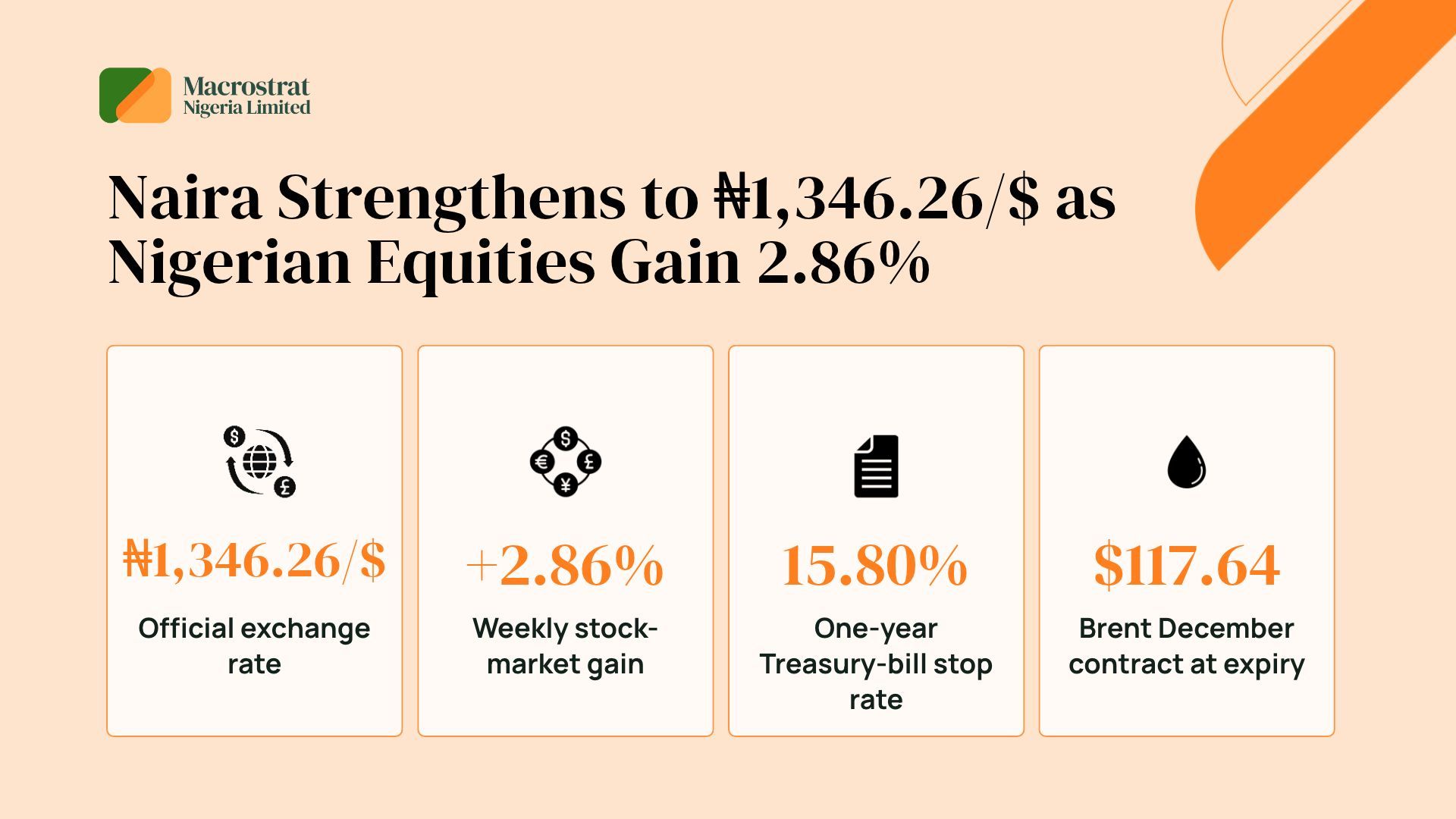
Review. The naira closed at ₦1,346.91/$ on 29 Oct and ₦1,346.26 on 30 Oct; interbank turnover fell from $244.1m (28 Oct) to $54.1m (29 Oct), reserves were $55.26bn and the parallel rate was near ₦1,390. On 28 Oct the DMO offered ₦800bn of bills, received ₦1.91trn of bids, sold ₦71.2bn and rejected ₦1.84trn, trimming the 364-day stop rate 10bp to 15.80%. Equities rallied: the ASI closed at 254,299.49 on 30 Oct, up 2.86% on the week and 63.42% year to date, lifting market capitalisation to ₦165.11trn. Dangote Refinery’s IPO closed on 27 Oct, raising about ₦2.15trn ($1.58bn) at ₦525 a share from 119 countries. Bank results diverged: Zenith’s nine-month pre-tax profit rose 1.2% to ₦928.8bn as impairments fell 70.5%, but GTCO’s fell 2.3% to ₦879.9bn as interest expense jumped 27.7%. On 27 Oct President Tinubu asked the Senate to approve $20.52bn and €1.05bn of external borrowing, with public debt at ₦166.79trn in June.
Outlook. The Stanbic IBTC PMI on 2 Nov is the main real-sector reading. The Senate’s debt committee will review the borrowing request, and Dangote must send allotment details to the SEC by 10 Nov. We expect continued DMO bid rejections, CBN dollar supply holding the naira near ₦1,346–1,347, and more Q3 earnings; oil near $117 supports reserves but raises pump-price risk.
–
Conclusion
Growth is holding, inflation is not falling, and markets are repricing AI and oil risk together. Nigeria enters the week with strong buffers (reserves above $55bn, record equities, a successful IPO) but tight money-market conditions, costlier bank funding and a large borrowing request.
–
Recommendations
Policymakers: publish FX-intervention data and weigh new borrowing against debt-service costs.
Businesses: hedge dollar costs, budget fuel at $110+ Brent and lock funding while one-year yields sit near 15.8%.
Investors: favour earnings-backed NGX names and stagger exposure around the 3 Nov midterms, 5 Nov Bank of England and 6 Nov payrolls.