Weekly Economic Review and Outlook: 31 August – 13 September

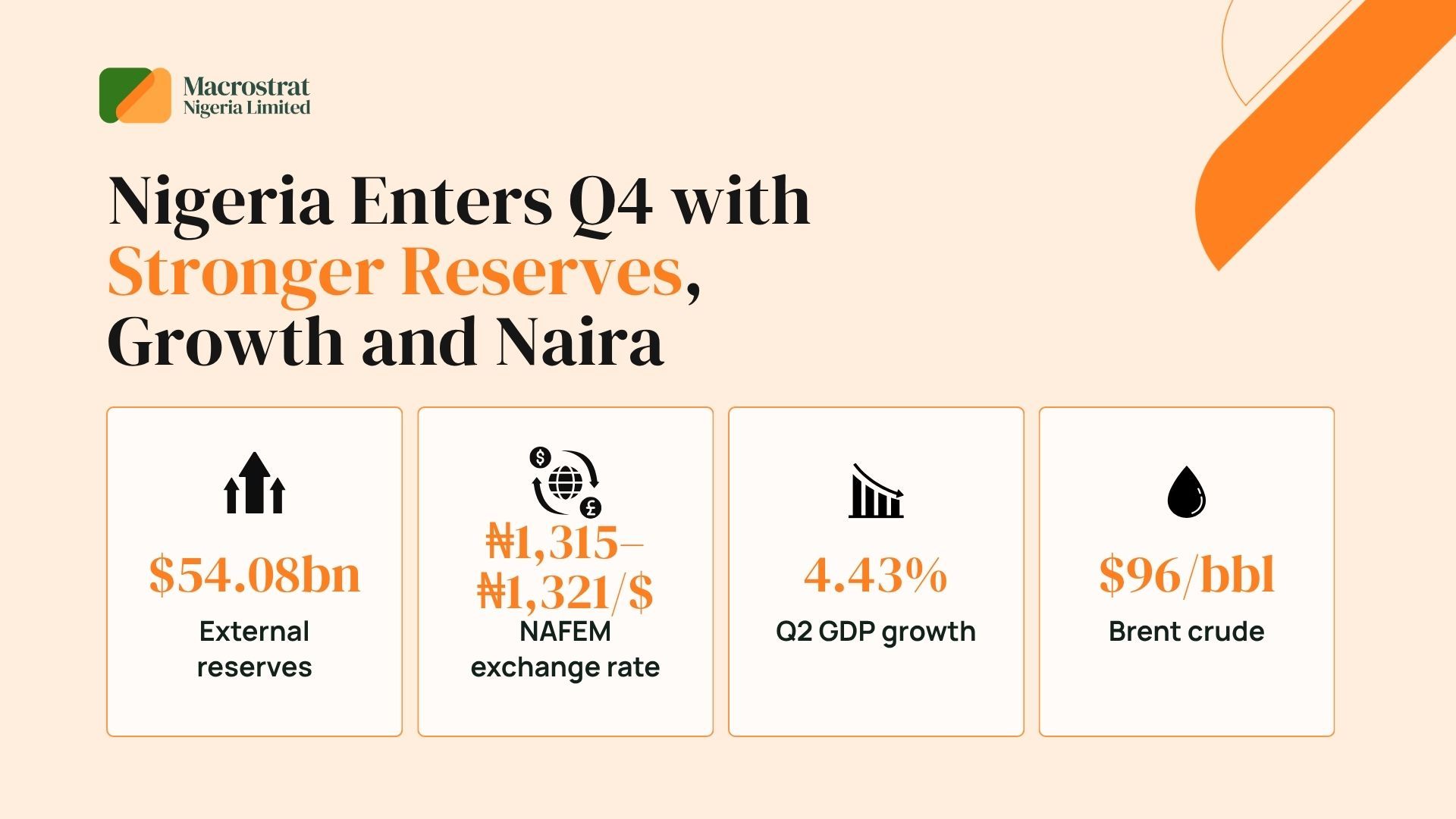
Executive Summary The week was dominated by a collision of hawkish monetary signalling, a global sovereign bond selloff, and renewed Middle East hostilities. For Nigeria, the story remained overwhelmingly positive: external reserves crossed $54.08 billion on September 3, the highest level in nearly 18 years, and the naira strengthened to around ₦1,315-₦1,321/$ at NAFEM, its firmest level since April 2024. Q2 2026 GDP growth was confirmed at 4.43% y/y, the fastest reading in five years. The coming week is dominated by a global central-bank super-cycle — US CPI/PPI (Sept 10-11) ahead of the FOMC (Sept 15-16), followed by the ECB, Bank of England and Bank of Japan — alongside Canada's dollar-for-dollar retaliatory tariffs taking effect September 8, and whether Middle East hostilities de-escalate or drag oil, bond yields and Nigeria's terms of trade higher still.
–
Week in Review (30 August – 6 September 2026) Nigeria External reserves rose to $54.08bn on September 3 (from $52.66bn on Aug 19), about $3.04bn above the CBN's own $51.04bn full-year target and gaining $8.51bn year-to-date, driven by crude-tax receipts and third-party inflows. The naira firmed steadily through the week, from ₦1,335.50/$ on Aug 31 to a two-year intraday high near ₦1,315-1,321/$ by Sept 4-5 at NAFEM. System liquidity rose 56.2% to ₦4.65trn in August on maturing OMO bills and FAAC disbursements. NBS confirmed Q2 2026 real GDP growth of 4.43% y/y, the strongest Q2 outturn in five years, aided by oil output rising to 1.72mbpd from 1.55mbpd in Q1. For the Capital markets, the NGX All-Share Index closed the week at 246,992.44 points, lifting market capitalisation to ₦159.56trn, with FTSE Russell's confirmed Sept 21 Frontier Market reclassification to its Frontier Index — the standout structural catalyst.
–
Africa Egypt and Ghana continued to outperform on the back of tighter monetary stances and improved external buffers, while Kenya's shilling held broadly stable near KES 129/$ on elevated carry-trade support.
–
Global The US labour market delivered a sharp upside surprise: August nonfarm payrolls rose 162,000 with unemployment steady at 4.1%, average hourly earnings up 0.3%, labour-force participation back to 61.6%, and June-July revised up a combined 55,000. This followed Fed Chair Kevin Warsh's hawkish Jackson Hole keynote (Aug 28) — his first as Chair, breaking two decades of forward-guidance tradition — which pushed CME FedWatch odds of a 25bp September hike from ~36% to 65-68% before settling near 50-60% after Governor Waller's more balanced remarks. The resulting bond selloff pushed the US 10-year yield above 4.80% and the 30-year toward 5.30% intraweek, before closing at 4.78% and 5.24% respectively. In Europe, August headline inflation printed at 3.3% y/y — a three-year high — though core and services inflation eased modestly; the ECB is nonetheless widely expected to hike when its Governing Council meets this week. China's official manufacturing PMI fell further below 50. Japanese government bond yields saw fresh volatility, with the 10-year JGB briefly touching 3.0% — its highest since September 1996 — and the 30-year near 4.2% on Bank of Japan rate-hike speculation, triggering a sharp yen appreciation and a fast unwind of leveraged yen carry trades before the yen closed the week at 156.24/$. US ISM Manufacturing eased to 54.6 from a near four-year high of 55.6, still its eighth straight month of expansion. Geopolitically, the US resumed strikes on IRGC targets on September 1 after Iran attempted to mine the Strait of Hormuz and struck two Saudi-bound tankers, with further US strikes on an Iranian tanker reported September 5, sending Brent crude from roughly $88/bbl to near $96/bbl — its strongest weekly gain since mid-July — and pushing US diesel to a fresh record retail high. Canada confirmed its dollar-for-dollar retaliatory tariffs (15-50%, on ~$27.6bn/$19.9bn of US goods spanning steel, dairy, appliances and electronics) will take effect September 8, escalating the North American trade war.
–
Outlook for Next Week (7–13 September 2026) Nigeria Expect the naira to hold broadly stable-to-firmer within a ₦1,300-₦1,330/$ NAFEM band, underpinned by record reserves (now above $54bn) and buoyant remittance inflows, though a further leg up in Brent (Iran-linked supply risk) would be a net positive for FX earnings and reserves. Markets will watch for the August CPI print from NBS (typically mid-month) for confirmation that food inflation pressure is easing, and continued NGX positioning ahead of the September 21 FTSE Frontier effective date.
–
Africa The rand and other Africa currencies remain most exposed to (a) the direction of US rate expectations into the September 16 FOMC and (b) further Brent volatility given the region's mixed oil-importer/exporter composition. Watch for SARB commentary on inflation risk from the renewed oil shock, and portfolio-flow data across frontier African markets as investors reprice for a possible Fed hike. Nigeria's reclassification remains the standout African capital-markets story into the second half of September.
–
Global The week opens a dense central-bank and data cycle. US CPI (Sept 10-11) and PPI are the critical prints ahead of the September 15-16 FOMC meeting. The FOMC is followed almost immediately by the ECB (widely expected to hike), the Bank of England (Sept 17) and the Bank of Japan (Sept 18) — a rare four-way major central-bank convergence that will set the tone for global yields and EM funding costs into Q4. The Eurozone releases Q2 GDP revisions and employment data, while China publishes trade-balance figures — tracking whether its surplus stays on pace to top last year's record $1.2 trillion — alongside fresh inflation readings. OPEC meets with output quotas widely expected to hold steady even as physical exports remain constrained by ongoing Strait of Hormuz and Red Sea disruptions. Canada's retaliatory tariffs take effect September 8, and markets will watch for further escalation or a return to talks between Ottawa and Washington. The Iran-US-Israel conflict trajectory remains the single largest swing factor for global energy prices, bond-market risk appetite, and EM current accounts and inflation; a further escalation risks a durable move above $100/bbl, while any de-escalation could unwind much of this week's oil and yield moves. Also watch US JOLTS, University of Michigan consumer sentiment, the Treasury's September 9 buyback operation, and earnings from Oracle (a read-through on enterprise cloud/AI-compute spending) for signals on the durability of the AI investment cycle amid tighter financial conditions.
–
Conclusion
- – Nigerian corporates and investors should treat the September 21 FTSE Frontier Market reclassification as an active positioning window: the addition of ten large caps to FTSE's Frontier Index is a genuine, dated catalyst for passive and active portfolio inflows.
- – Record external reserves ($54bn+) and a firming naira give Nigeria a strong external buffer heading into Q4, but sustainability still hinges on oil receipts and non-oil FX inflows — treat the current window as favourable for building FX cover.
- – The Iran-Israel-US conflict, not the Fed alone, is now the dominant swing factor for global energy prices, Nigeria's terms of trade, and Africa's oil-importer inflation outlook; monitor Strait of Hormuz developments as closely as the September 11 US CPI and September 16 FOMC decision.
- – The synchronized global bond selloff (US 10Y/30Y, UK gilts, JGBs) and signs that reliable Treasury buyers (Norway, China, Japan, GCC) are stepping back is a structural risk to watch: a sustained rise in global long-end yields would tighten financial conditions for emerging markets, including Nigeria, even as domestic fundamentals improve — diversified funding and FX cover remain the appropriate hedge.