Will Nigeria’s Stable Naira Keep Inflation Easing?
Executive Summary
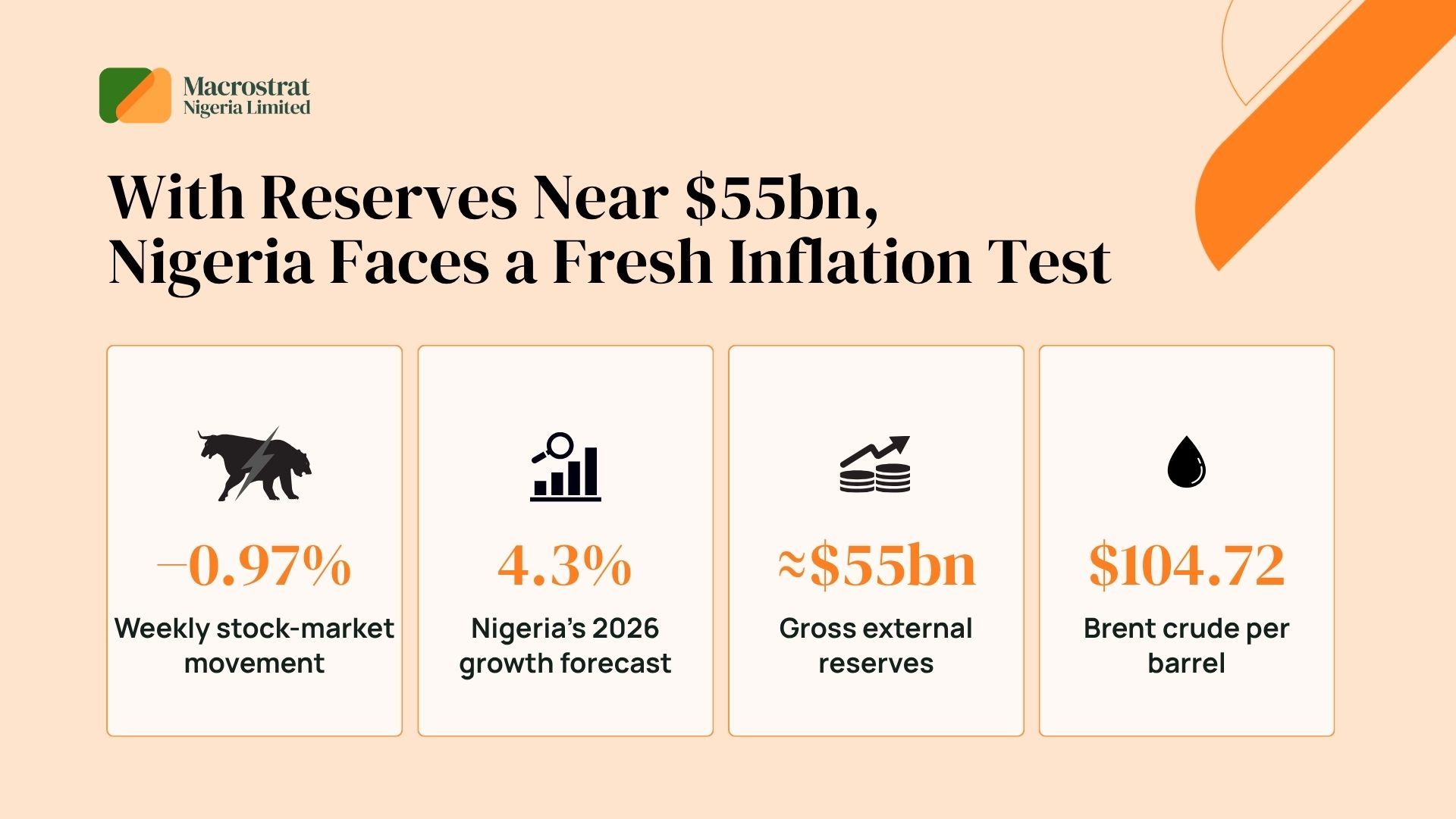
Markets balanced record US equities against multi-decade bond yields and oil above $100. The US 10-year yield touched 5.35% on 7 October, the highest since 2002, as Fed minutes showed most officials expect another hike by year-end. Brent closed at $104.72 on 9 October. Kenya held its rate at 8.75% on 7 October, and the World Bank lifted 2026 Sub-Saharan growth to 4.3% on 6 October. Nigeria's gross reserves neared $55bn on 9 October, the naira held near N1,331 per dollar on 5 October, and the NGX All-Share Index fell 0.97% on the week to 248,363.55. Next week turns on the IMF Outlook (13 October), US CPI (14 October) and Nigeria's CPI (about 15 October).
–
Introduction
This note reviews 5-11 October 2026 and previews 12-18 October 2026. Forecasts and recommendations are Macrostrat's own judgement.
–
The World
Review.
US yields set the tone. The 10-year touched 5.35% on 7 October before a strong $39bn auction pulled it to about 5.29%; French 10-year yields rose 12bp to 4.876% and UK gilts to 5.447%. The minutes of the 15-16 September meeting said most participants see another rise as likely appropriate by year-end. France now trades at wider spreads than Italy, and the US deficit is near 6% of GDP. US equities still ended the week near records, the S&P 500 at 7,811.51 on 9 October, but the AI trade wobbled on 8 October when the Financial Times reported OpenAI's annualised revenue near $50bn, not $70bn; Nvidia fell about 3% and Oracle nearly 6%. Brent ranged from $97.06 to $105.92 and settled at $104.72 amid Hormuz tanker attacks and a hurricane; a 9 October Trump-Putin deal for 300,000 tonnes of diesel and two attacks on Riyadh's airport that killed three people added to the swings.
Outlook.
The IMF presents its World Economic Outlook and Financial Stability Report on 13 October, the Fiscal Monitor on 14 October, and the plenary on 16 October in Bangkok, with AI, energy prices and record public debt flagged as the key forces. US September CPI (14 October) is forecast at +0.6% monthly and 3.6% yearly, core +0.2% and 2.5%; PPI and retail sales follow on 15 October. JPMorgan, Goldman Sachs, Citigroup and Wells Fargo open earnings on 13 October, with S&P 500 third-quarter profit growth expected near 29.5%. China's CPI (14 October) is seen near 0.9-1.0%, UK August GDP (15 October) at -0.1%, and eurozone inflation lands on 16 October. A hot CPI would revive pricing for an October hike, now near 20%.
–
–
Africa
Review.
The World Bank's 6 October update lifted Sub-Saharan growth to 4.3% in 2026, 0.3 points above April, upgraded nearly three-quarters of countries including Nigeria, and sees median inflation rising from 3.7% to 5.5% on fuel, fertiliser and food costs. Kenya held at 8.75% on 7 October, a fourth straight hold, as September inflation rose to 6.8% from 6.6%; it raised 2026 growth to 5% and projects a current-account deficit of 3.2% of GDP. Outlook. Bangkok (12-18 October) is the main event. Imported energy inflation, falling aid and debt service will frame African ministers' financing requests, and a hot US CPI would lift dollar-funding costs. We expect oil importers to stay cautious on rates while exporters such as Nigeria benefit from terms of trade.
–
Nigeria
Review.
Gross reserves reached about $55bn, an all-time high, with net reserves at $46bn on 9 October. The naira was N1,331.69 per dollar on 5 October, with the parallel rate at N1,360; the second-quarter trade surplus was $9.22bn and remittances $5.49bn. At the 7 October Treasury-bill auction, stop rates were 15.50% (91-day) to 15.85% (364-day) while demand fell 58% to N1.77tn as funds moved to OMO bills1. The NGX All-Share Index lost 0.97% to 248,363.55, with banks down 2.64%. The World Bank raised Nigeria's 2026 growth forecast to 4.3% and sees 4.4% in 2027-28. Outlook. The NBS releases September CPI about 15 October; August was 15.39%. We expect a narrow move as naira stability offsets food-price risk. Watch the pass-through of the 350bp rate cut to lending rates, the next Treasury-bill auction, and Nigeria's engagement at the Bangkok meetings.
–
Conclusion
The world economy is resilient but fragile: strong equities sit on high yields, costly oil and an unfinished war. Nigeria has record reserves, a steadier naira and upgraded forecasts, but tighter liquidity and softer equities.
–
Recommendations
Policymakers: keep building reserves and FX transparency, and speed rate-cut pass-through through liquidity management.
Businesses: hedge dollar costs while the naira is stable, lock in medium-term funding, and price in diesel risk.
Investors: stay selective on equities, favour earnings-backed names before Q3 results, and watch US CPI.